Search
Results
Leverage of OWL-DL axioms in a Contact Centre for Technical Product Support
Abstract
Real-time access to complex knowledge is a business driver in the contact centre environment. In this paper we outline for the domain of telecom technical product support a knowledge sharing paradigm in which a desktop client annotates named entities in technical documents with canonical names, class names or relevant class axioms, derived from an ontology by means of a web services framework. We described the system and its core components; OWL-DL telecom hardware ontology, ontological-natural language processing pipeline, an ontology axiom?extractor; and the Semantic Assistants framework.
Multi-lingual Noun Phrase Chunker Updated
Submitted by rene on Sat, 2007-03-03 09:08.I just posted a small update to my multi-lingual noun phrase chunker (MuNPEx) for GATE.
Changes in v0.2 are:
o preliminary Spanish support (see below)
o renamed from "NPE" to "MuNPEx" in a blatant attempt on Googlewhacking
o small cleanups
o now comes with a sample NE transducer for number markup to improve chunking
Supported languages are now English, German, French, and Spanish (beta).
The FungalWeb Ontology: Application Scenarios
Abstract
The FungalWeb Ontology aims to support the data integration needs of enzyme biotechnology from inception to product roll out. Serving as a knowledge base for decision support, the conceptualization seeks to link fungal species with enzymes, enzyme substrates, enzyme classifications, enzyme modifications, enzyme retail and applications. We demonstrate how the FungalWeb Ontology supports this remit by presenting application scenarios, conceptualizations of the ontological frame able to support these scenarios and semantic queries typical of a Biotech Manager. Queries to the knowledge base are answered with description logic (DL) and automated reasoning tools.
Engineering a Semantic Desktop for Building Historians and Architects
Abstract
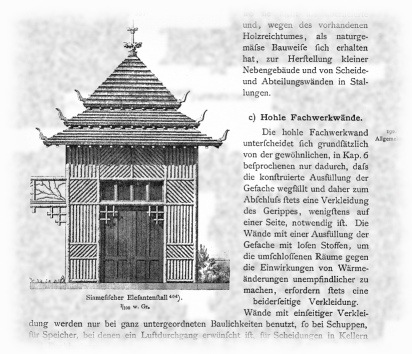
We analyse the requirements for an advanced semantic support of users—building historians and architects—of a multi-volume encyclopedia of architecture from the late 19th century. Novel requirements include the integration of content retrieval, content development, and automated content analysis based on natural language processing.
We present a system architecture for the detected requirements and its current implementation. A complex scenario demonstrates how a desktop supporting semantic analysis can contribute to specific, relevant user tasks.
A Context-Driven Software Comprehension Process Model
Abstract
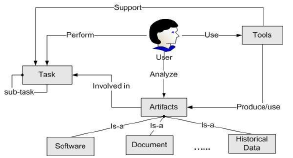 Comprehension is an essential part of software evolution. Only software that is well understood can evolve in a controlled manner. In this paper, we present a formal process model to support the comprehension of software systems by using Ontology and Description Logic. This formal representation supports the use of reasoning services across different knowl- edge resources and therefore, enables us to provide users with guidance during the comprehension process that is context sensitive to their particular comprehension task. As part of the process model, we also adopt a new interactive story metaphor, to represent the interactions between users and the comprehension process.
Keywords: Software evolution, program comprehension, process modeling, story metaphor, ontological reasoning
A Unified Ontology-Based Process Model for Software Maintenance and Comprehension
Abstract
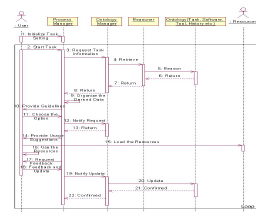 In this paper, we present a formal process model to support the comprehension and maintenance of software systems. The model provides a formal ontological representation that supports the use of reasoning services across different knowledge resources. In the presented approach, we employ our Description Logic knowledge base to support the maintenance process management, as well as detailed analyses among resources, e.g., the traceability between various software artifacts. The resulting unified process model provides users with active guidance in selecting and utilizing these resources that are context-sensitive to a particular comprehension task. We illustrate both, the technical foundation based on our existing SOUND environment, as well as the general objectives and goals of our process model.
Keywords: Software maintenance, process modeling, ontological reasoning, software comprehension, traceability, text mining.
An Ontological Software Comprehension Process Model

Abstract
Comprehension is an essential part of software maintenance. Only software that is well understood can evolve in a controlled manner. In this paper, we present a formal process model to support the comprehension of software systems by using Ontology and Description Logic. This formal representation supports the use of reasoning services across different knowledge resources and therefore, enables us to provide users with guidance during the comprehension process that is context sensitive to their particular comprehension task.
Keywords: Software maintenance, program comprehension, process modeling, ontological reasoning
An Ontology-based Approach for the Recovery of Traceability Links
Abstract
 Traceability links provide support for software engineers in understanding the relations and dependencies among software artifacts created during the software development process. In this research, we focus on re-establishing traceability links between existing source code and documentation to support reverse engineering. We present a novel approach that addresses this issue by creating formal ontological representations for both the documentation and source code artifacts.
Generating Update Summaries for DUC 2007
Abstract
Update summaries as defined for the new DUC 2007 task deliver focused information to a user who has already read a set of older documents covering the same topic. In this paper, we show how to generate this kind of summary from the same data structure—fuzzy coreference cluster graphs—as all other generic and focused multi-document summaries. Our system ERSS 2007 implementing this algorithm also participated in the DUC 2007 main task, without any changes from the 2006 version.

Semantic Assistants: SOA for Text Mining
With the rapidly growing amount of information available, employees spend an ever-increasing proportion of their time searching for the right information. Information overload has become a serious threat to productivity. We address this challenge with a service-oriented architecture that integrates semantic natural language processing services into desktop applications.